The Hidden Cost of Manufacturing Downtime: How to Find the Problems Your Reports Miss
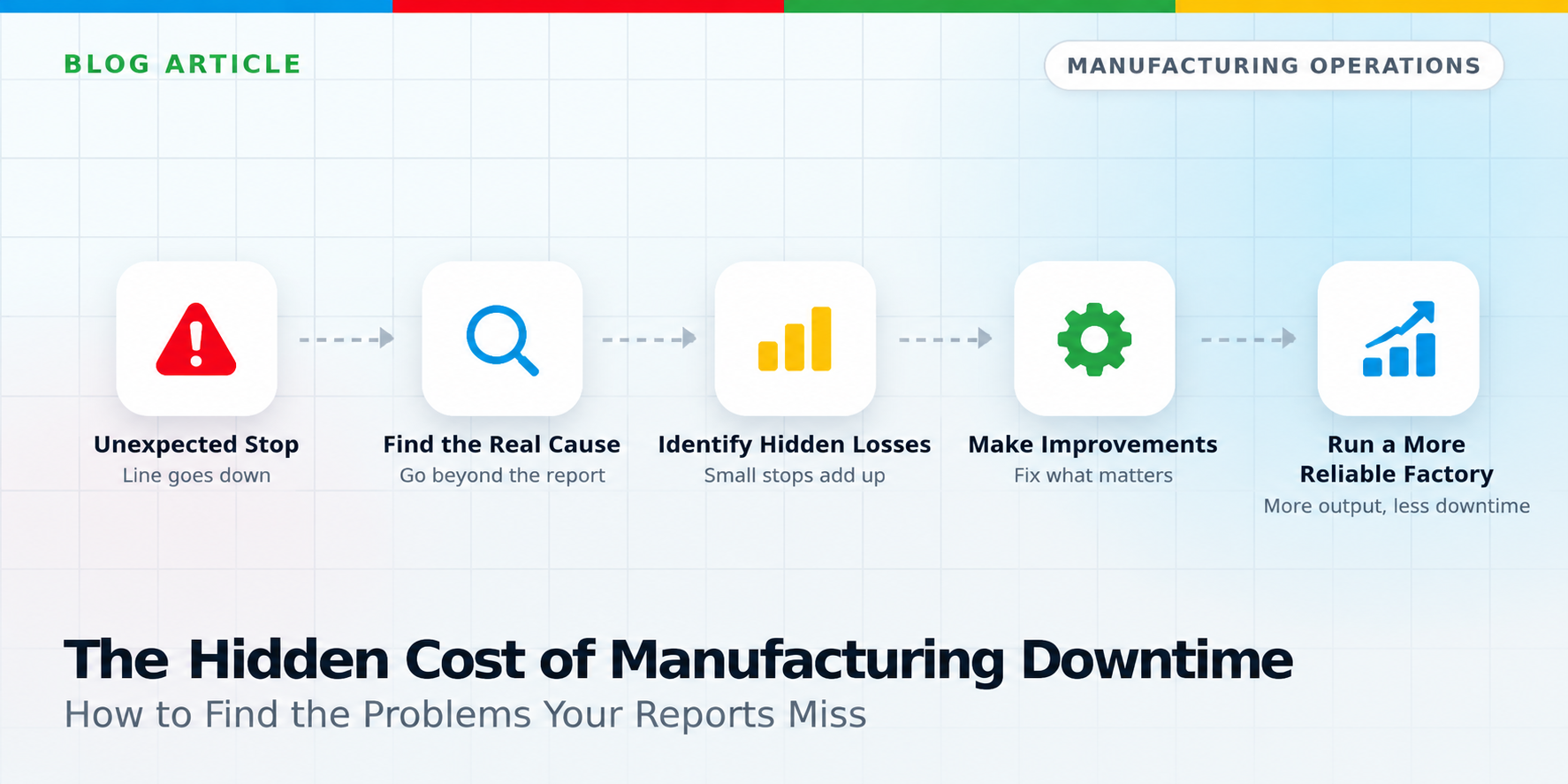
A machine breaks down. The line stops. Someone calls maintenance, the delay gets written in the shift report, and everyone knows what happened.
But what about the machine that stops for 30 seconds, starts again, and stops again ten minutes later? What about the operator waiting for a part, a slow changeover, or a jam that is cleared before anyone records it?
These small delays can be easy to miss. They may not look serious on their own, but they take time away from making products. By the end of a shift, the factory may have made fewer items than planned, even though the report shows only a little downtime.
That is the hidden cost of manufacturing downtime: not just the big breakdowns everyone sees, but also the lost minutes that never make it into the report.
1. Why your downtime report may not tell the whole story
A report is only as useful as the information put into it. If a stop is not recorded, it is hard to understand how often it happens or how much time it takes away.
Long breakdowns are usually easy to remember. Short stops are different. A worker may clear a jam in seconds and get the line moving again. There may be no time to write it down. The same thing happens with small delays caused by missing materials, sensor issues, waiting between steps, or a changeover that takes longer than planned.
After many small delays, the lost time can be much bigger than anyone expects. The report may be correct about the stops it contains, while still missing part of the story.
2. Small stops add up: a simple example
Imagine a production line has ten short stops every hour. Each stop lasts just 30 seconds. That sounds tiny.
But across an eight-hour shift, those stops add up to 40 minutes. That is 40 minutes the line could not run as planned.
This is an example, not a benchmark. Your factory’s numbers will be different. The lesson is simple: count how often a problem happens as well as how long each event lasts. A short delay that repeats all day may deserve more attention than a longer delay that happens once a month.
3. Look beyond machine breakdowns
When output falls short, it is tempting to blame the machine. Sometimes that is the right answer. Sometimes the machine is only one part of the problem.
· Small or repeated stops: jams, misfeeds, blocked sensors, or quick resets.
· Waiting for materials: the line is ready, but the next part or ingredient has not arrived.
· Slow changeovers: the team needs more time than planned to switch to the next product.
· Waiting between steps: one process finishes, but the next station is not ready.
· Missing or unclear records: the team knows output was low but cannot explain where the time went.
The goal is not to find someone to blame. It is to find what keeps getting in the way and make it easier for the team to do good work.
4. Five practical ways to find hidden downtime
Step 1: Compare planned output with actual output
Start with one line and one shift. How many good products did the team plan to make? How many did it actually make? If there is a gap, write it down. You do not need a perfect system to start asking better questions.
Step 2: Watch the work, not just the report
Spend time on the factory floor. Look for waiting, repeated adjustments, short jams, and places where products build up. Ask operators what slows them down. They often see problems that are hard to spot in a summary report.
Step 3: Record every stop in the same way
Agree on what counts as a stop and use a short list of reasons. For each event, capture the machine or line, start time, end time, length, and likely reason. Keep the list simple enough for every shift to use it. If the cause is not clear, record that honestly instead of guessing.
Step 4: Look for patterns
Review the records every day or week. Which problem happens most often? Which one takes the most time? Does it happen on one machine, one product, or one shift? A simple ranked list can help the team choose what to investigate first.
Step 5: Fix one cause and check the result
Choose one problem the team can act on. Try a fix, then measure the same thing again. Did the stops become less frequent? Did output improve? If not, learn from the result and try the next idea. The point is to turn information into action, not to create another report that nobody uses.
5. Make the numbers useful
Downtime data matters when it helps people make a better decision. A list of stops is a starting point, not the finish line.
Once the team knows what is happening, it can estimate the impact. For example, it can calculate the time lost to a repeated jam, compare that with the time needed to fix it, and decide what to do first. Use your own production rates and costs when working out the money involved. Avoid treating a rough estimate as an exact saving.
If manual records keep missing short stops, consider whether machine data or a Manufacturing Execution System (MES) could help capture events more consistently. Technology can make the problem easier to see, but the team still needs to understand the cause and act on it.
A simple downtime check for your next shift
· Compare planned output with actual good output.
· Ask operators where they lost time, including short waits and repeated resets.
· Record when each stop started, when it ended, and what may have caused it.
· Rank the top three causes by frequency and total time lost.
· Pick one cause, test one improvement, and check the result.
You do not need to solve every problem at once. Start with one line, collect better information, and follow the evidence. Small improvements can make a real difference when they remove a problem that keeps coming back.
Closing
The biggest downtime problem is not always the breakdown that stops the whole factory. Sometimes it is the small delay that happens so often that everyone gets used to it.
When you measure what is really happening, listen to the people doing the work, and check whether your fixes help, your reports become more than a record of the past. They become a guide to what to improve next.
FactoryWorx works with manufacturers exploring better production visibility and connected operations. Learn more at https://www.factoryworx.com.au/.