How One Plasterboard Manufacturer Stopped Running Its Plant on Paper and Guesswork
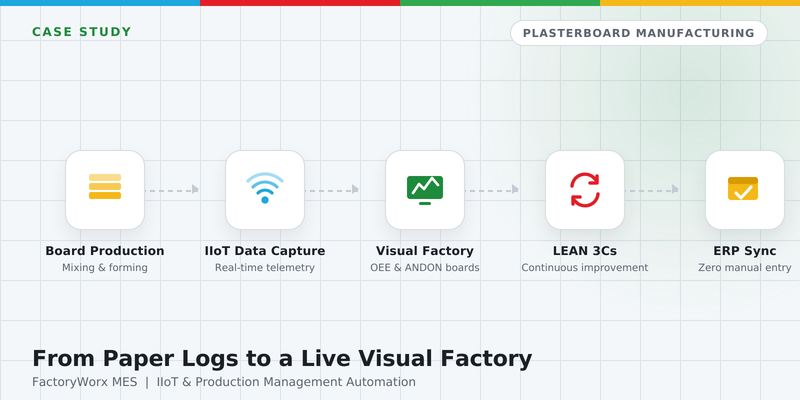
One of Australia's biggest plasterboard makers used to track downtime, waste, and quality by hand. Here's what changed once FactoryWorx gave them a live view of every line.
● Paper logs → real-time OEE tracking
● Guesswork → precise wet vs. dry waste tracking
● Manual ERP entry → fully automated, two-way sync
This manufacturer makes plasterboard, drywall, and insulation at a speed most industries would find terrifying. Mixing, forming, drying, cutting, stacking — it all happens fast, and one small mistake can waste a lot of board in a hurry.
For a long time, this plant ran things the same way a lot of plants still do. Downtime got written on paper. Waste got estimated at the end of a shift. Quality checks only caught a problem after it had already happened.
Then they brought in FactoryWorx.
What's Inside This Case Study
This isn't a highlight reel. It's the real breakdown of what changed on this plant's floor, written the way we'd explain it to a plant manager, not a shareholder.
● The five actual problems this plant was dealing with before FactoryWorx, in plain operational terms
● How FactoryWorx connected straight into existing PLCs, sensors, and cutting equipment — no machinery replaced
● The exact six-step flow, from an order landing in the ERP to a shift closing itself out
● A full before-and-after comparison across OEE visibility, waste, ERP syncing, and continuous improvement
● Why their LEAN 3Cs process (Concern, Cause, Countermeasure) actually stuck, instead of fading out after a few weeks like most improvement efforts do
Why This One's Worth Reading
This isn't a small operation testing out new software. It's one of the leading names in plasterboard and wall lining in the country, running continuous lines at serious volume. If a system can hold up on a floor like that, it's worth seeing exactly how.
If your line still runs on paper and end-of-shift guesswork, this is worth five minutes of your time.